
Continuation vehicles solve a familiar private markets problem: a strong portfolio company still has substantial room to grow even when the original sponsor fund is nearing the end of its life.
That tension is especially relevant for 2016-vintage private equity and venture funds. A sponsor may have one or more portfolio companies that are not yet mature enough for an optimal sale, may not command the returns the sponsor or LPs expected in the current market, or may simply be worth holding longer because the real value-creation phase is still ahead. In those cases, a continuation vehicle (CV), continuation fund, or asset-level SPV can offer a practical alternative to a forced exit.
Why this matters now
Recent coverage of EQT’s first continuation vehicle for assets from its inaugural venture fund illustrates how established sponsors are using these tools to generate liquidity for existing LPs while preserving ownership of selected companies with additional upside. The Wall Street Journal reports that EQT’s new continuation vehicle raised about 526 million €, or roughly $599 million, with HarbourVest Partners leading the financing, and the vehicle was formed to acquire selected tech companies from EQT Ventures I’s portfolio.
The significance of that transaction is broader than EQT. It reflects the normalization of GP-led secondaries and continuation structures as portfolio management tools rather than exotic or last-resort solutions. The core idea is straightforward: not every high-quality asset should be sold merely because the original fund’s timing says it is time.
The 2016 vintage fund problem
For older funds, the challenge is often not whether an exit is possible, but whether an exit is sensible. A sponsor may face several overlapping realities:
The portfolio company is performing well, but still needs time to reach a more attractive scale or profitability profile.
Public markets or M&A conditions may not support a premium valuation.
Debt markets may make a recapitalization less attractive than in the past.
The sponsor may believe the next phase of value creation is best delivered by the same team, under a refreshed capital structure.
This is where continuation vehicles become strategically useful. They allow the sponsor to separate asset quality from fund age. Instead of forcing a sale because the fund is aging, the sponsor can move selected assets into a new structure designed around the asset’s actual timeline.
What a continuation vehicle can do
In a well-structured transaction, a continuation vehicle can serve several goals at the same time:
Provide liquidity to LPs that want cash today.
Allow existing LPs to roll some or all of their exposure into the new vehicle.
Give the sponsor more time to continue building value in the asset.
Create a cleaner governance and capital structure around one company or a small group of companies with a similar investment thesis.
Avoid a sale into a weak market or at a point before the company has reached its full value potential.
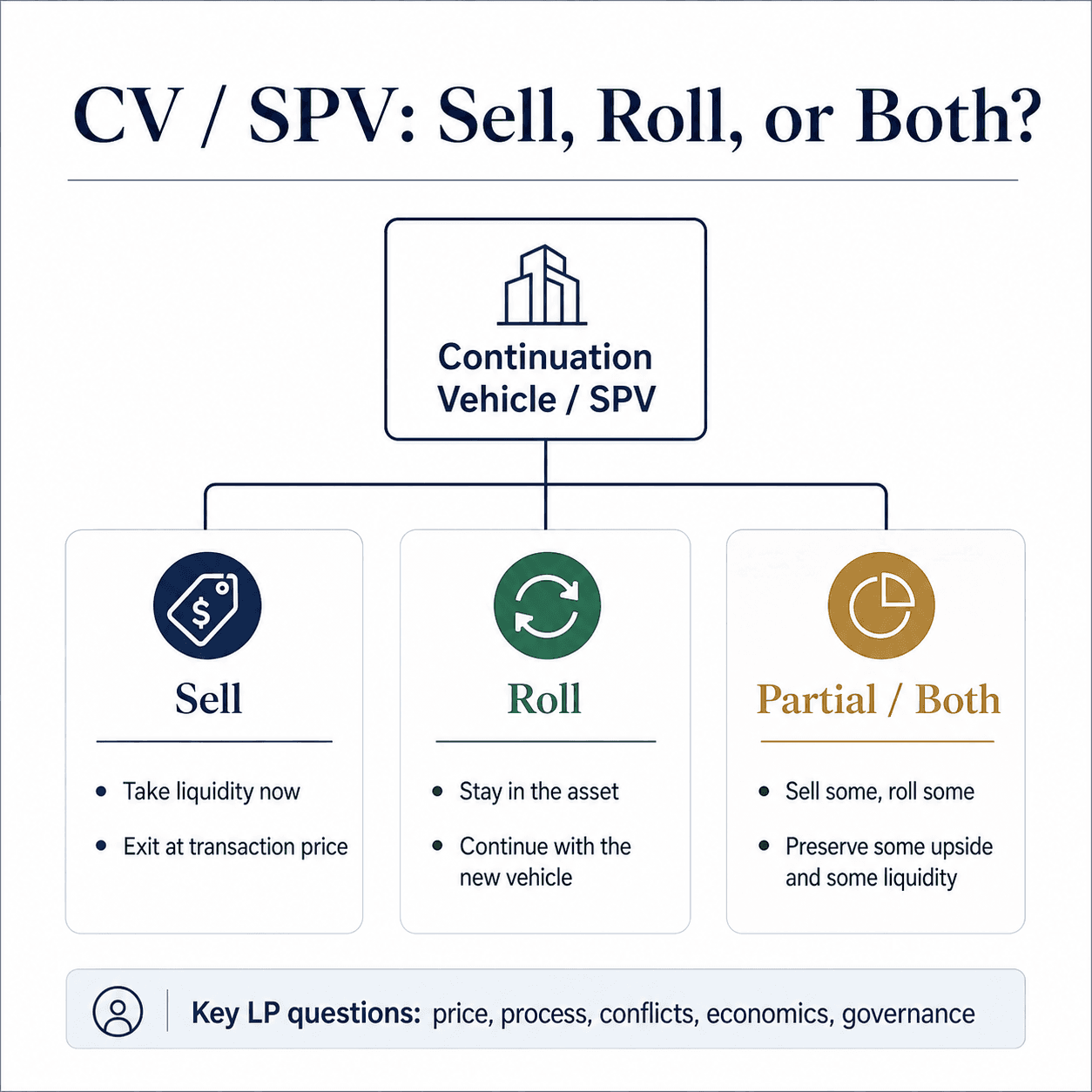
That optionality is one of the strongest arguments in favor of the structure. Rather than forcing every LP into the same outcome, a continuation vehicle can create a tailored choice set: exit now, continue investing, or in some cases do both.
Why continuation vehicles fit a patient-capital theory
Continuation vehicles also fit a broader theory of patient or evergreen-style capital. A fixed fund term is a useful discipline, but it can also create artificial pressure if the strongest portfolio company is still compounding value when the clock runs down.
The question shouldn’t be: can the sponsor exit? “Yes” is always the answer to that question. The better question to ask: is an exit is the best outcome for the company, the fund, and the LP base? When the answer is “no,” a continuation vehicle can provide a commercially rational bridge between a maturing fund and an asset that still deserves time.
This is one reason continuation vehicles are attractive in both buyout and venture contexts. In both, the structure gives the sponsor a way to align fund mechanics with business reality rather than the fund’s age dictating the business outcome.
Alternatives to a forced exit
A continuation vehicle is not the only option for an aging fund, but it is often more flexible than historical alternatives. Sponsors generally face some version of the following:
Path | Benefit | Constraint |
Traditional sale | Immediate liquidity and a clean exit | Will lock in a valuation (may be low) and likely cut off future upside |
IPO or public exit | Potential valuation upside and market visibility | Timing may be poor or the company may not be ready |
Fund extension | Buys time without moving the asset | Keeps all LPs in the same structure whether they want liquidity or not |
Dividend recap or refinancing | Partial liquidity without full exit | Depends heavily on debt market conditions and leverage tolerance |
Continuation vehicle / SPV | Lets some LPs exit and others roll while preserving upside | Requires rigorous pricing, process, and conflict management |
What makes the continuation vehicle distinctive is LP choice. It is often the only path that can simultaneously provide liquidity, preserve upside, and reset the holding period in a new structure.
The legal and structuring issues that matter most
Continuation vehicles may look elegant in theory, but they are governance-heavy transactions in practice. Because the sponsor is effectively sitting on both sides of the deal, process integrity matters as much as valuation.
The legal and commercial issues that deserve the most attention include:
Valuation and pricing
How the asset is priced is often the central issue. LPs need enough information to assess whether the sale price reflects a fair market outcome, especially where the asset is being sold into a vehicle controlled by the same GP. Independent valuations, fairness opinions, third-party bids, or a credible auction or market-check process may all be relevant depending on the transaction.
Conflicts of interest
A continuation vehicle is inherently conflict-sensitive. The GP owes duties in managing the old fund while also seeking to create a viable new vehicle. LPs will want to know how those conflicts were identified, disclosed, and managed.
LP disclosure and election mechanics
The rollover decision is only meaningful if LPs receive enough information, enough time, and clear enough election materials to evaluate their choices. Industry guidance from ILPA emphasizes greater transparency and consistency in these transactions, underscoring that process quality is essential to execution quality.
Fees, expenses, and economics
LPs also need to understand what changes economically in the new vehicle. That includes management fee treatment, carried interest structure, transaction expenses, any stapled commitments, and whether rollover investors are being asked to accept materially different economics.
Governance and post-closing oversight
The new vehicle should not just replicate the old issues in a new wrapper. Governance rights, reporting expectations, exit controls, advisory processes, and investor protections should all be reviewed with care so that the continuation vehicle is genuinely fit for purpose.
Questions LPs should ask before rolling into a continuation vehicle
The following questions are designed to help investors determine if participating in a CV is the right choice.
Questions about the asset(s)
Why is this asset being moved into a continuation vehicle instead of being sold to a third party now?
What specific value-creation plan supports a longer hold period?
What milestones has the company already achieved, and what remains to be done before a future exit?
What is the expected time horizon for the new vehicle?
What are the principal risks in holding the asset longer?
Questions about price and process
How was the asset valued?
Was there a formal auction, third-party market check, or independent fairness opinion?
Who selected the valuation adviser or fairness provider?
Were other buyers approached, and if so, what did that process show?
How does the sponsor support the view that the transaction price is fair to existing LPs?
Questions about conflicts and governance
How is the GP managing the conflict of being on both sides of the transaction?
What approvals, consents, or advisory committee processes apply?
What disclosures were given to LPs, and how early?
Will the new vehicle have different governance rights or investor protections than the old fund?
What reporting will rollover investors receive after closing?
Questions about economics
What are the management fee and carry terms in the new vehicle?
How are transaction expenses allocated between the old fund, the new vehicle, and incoming investors?
Are rollover LPs being diluted, advantaged, or disadvantaged relative to new capital?
Is there any stapled commitment or other commercial condition tied to the rollover decision?
How does the sponsor’s own economics change as a result of the transaction?
Questions about optionality and liquidity
What choices do LPs actually have: full exit, full rollover, or a mix?
How long do LPs have to make that decision?
What information will be available before the election deadline?
If an LP wants liquidity, how is the cash price determined and funded?
If an LP rolls, what new risks is that LP taking on compared with remaining in the old fund?
Questions about the sponsor’s thesis
Is this transaction being done because the asset is strong, or because the sponsor cannot obtain an acceptable sale today?
What would make the sponsor sell the asset now instead of continue to hold it?
Does the continuation vehicle represent delay or disciplined patience?
Why is this the right structure for this asset at this moment?
What sponsors should be prepared to explain
From a sponsor perspective, the best continuation vehicle narratives are precise, not promotional. A persuasive sponsor explanation should cover four points clearly:
Why the asset merits additional hold time.
Why this structure is better than a traditional sale or fund extension.
Why the price and process are fair to existing LPs.
Why the new vehicle’s economics and governance are aligned with the asset’s next phase of growth.
That clarity matters because continuation vehicles are scrutinized by investors and regulators. Reports in the first half of 2026 indicate heightened attention to valuations, conflicts, and disclosures in GP-led transactions, including SEC interest in how these deals are priced and governed.
Practical takeaway
Continuation vehicles are most compelling when they are used to preserve and create additional upside in genuinely strong assets, not to warehouse unresolved problems. The structure is at its best when it gives LPs real choice, uses a defensible process, and reflects a coherent theory of value creation over time.
For 2016-vintage funds, that may be the most important lesson. A maturing fund does not always need a forced exit. Sometimes it needs a new structure, better aligned with both the company’s timeline and investors’ differing liquidity needs.
" height="39.101000457763675px" id="v3jGvdhkA" transform="translate(0 0.5)" width="471.9989968261719px"/><path d="M 273.539 23.743 L 273.56 23.743 C 284.594 23.743 286.632 15.955 286.632 11.698 C 286.632 5.394 281.581 0.455 272.585 0.455 L 255.027 0.455 L 255.135 23.721 Z M 272.076 4.972 C 277.777 4.972 281.039 8.243 281.039 12.37 C 281.039 16.497 277.842 19.118 272.141 19.118 L 260.684 19.118 L 260.619 4.972 Z M 18.512 23.743 L 18.534 23.743 C 29.567 23.743 31.604 15.955 31.604 11.698 C 31.605 5.394 26.555 0.455 17.559 0.455 L 0 0.455 L 0.108 23.721 Z M 17.049 4.972 C 22.749 4.972 26.012 8.243 26.012 12.37 C 26.012 16.497 22.815 19.118 17.114 19.118 L 5.658 19.118 L 5.593 4.972 Z M 300.669 34.704 L 300.669 27.003 L 295.076 27.003 L 295.076 39.556 L 321.847 39.556 L 321.847 34.704 Z M 295.076 0.455 L 295.076 23.743 L 300.669 23.743 L 300.669 0.455 Z M 398.972 23.72 C 393.856 15.965 376.688 19.085 376.688 10.961 C 376.688 7.539 379.528 4.755 386.182 4.755 C 389.651 4.755 393.498 5.762 396.923 7.939 L 398.766 3.466 C 395.514 1.235 390.767 0 386.182 0 C 375.897 0 371.204 5.145 371.204 11.178 C 371.204 21.154 382.378 21.435 389.38 23.721 C 389.401 23.731 389.434 23.742 389.455 23.742 L 398.972 23.742 M 435.854 34.704 L 435.854 39.556 L 407.458 39.556 L 407.458 23.624 L 413.05 23.623 L 413.05 34.703 L 435.854 34.703 Z" fill="rgb(37, 75, 117)" height="39.55600025939941px" id="MEnZDRgPJ" transform="translate(36 0)" width="435.8540078125px"/><path d="M 26.771 10.961 L 26.771 15.813 L 0 15.813 L 0 0 L 5.593 0 L 5.593 10.96 L 26.771 10.96 Z M 99.203 3.107 C 99.203 3.107 99.268 3.205 99.29 3.259 L 99.279 3.259 C 99.279 3.259 99.235 3.151 99.203 3.107 Z" fill="rgb(37, 75, 117)" height="15.812999999999999px" id="FE_6wC8sG" transform="translate(331 23.5)" width="99.29000292968749px"/><path d="M 400.305 7.407 C 400.305 13.387 395.504 18.52 385.153 18.52 C 379.181 18.52 373.307 16.517 370.175 13.603 L 372.245 9.249 C 375.149 11.87 380.124 13.766 385.153 13.766 C 391.927 13.766 394.832 11.144 394.832 7.743 C 394.832 7.592 394.821 7.451 394.81 7.31 C 394.81 7.245 394.81 7.17 394.788 7.104 C 394.767 6.85 394.717 6.599 394.637 6.357 C 394.616 6.28 394.591 6.203 394.561 6.129 C 394.552 6.1 394.541 6.071 394.528 6.043 C 394.497 5.954 394.461 5.868 394.42 5.783 C 394.387 5.696 393.639 4.006 389.379 2.263 L 398.896 2.241 C 399.914 3.931 400.197 5.772 400.208 5.901 C 400.229 6.075 400.251 6.259 400.262 6.454 C 400.273 6.552 400.283 6.649 400.283 6.747 C 400.283 6.963 400.305 7.18 400.305 7.407 Z M 367.91 18.076 L 362.046 18.076 L 355.272 2.241 L 360.713 2.241 Z M 339.599 2.24 L 332.619 18.076 L 326.875 18.076 L 334.039 2.263 L 339.599 2.241 Z M 172.516 1.548 L 181.273 18.065 L 187.364 18.065 L 177.729 0 C 175.8 0.996 172.516 1.549 172.516 1.549 Z M 0 18.076 L 5.593 18.076 L 5.593 2.263 L 0.033 2.241 Z" fill="rgb(37, 75, 117)" height="18.51999993705749px" id="lrM07ntHs" transform="translate(36 21.5)" width="400.30498779296875px"/><path d="M 209.778 23.288 L 209.799 23.288 C 220.833 23.288 222.87 15.5 222.87 11.243 C 222.87 4.939 217.82 0 208.824 0 L 191.266 0 L 191.374 23.266 Z M 208.314 4.517 C 214.015 4.517 217.278 7.788 217.278 11.915 C 217.278 16.042 214.08 18.663 208.379 18.663 L 196.923 18.663 L 196.858 4.517 Z M 191.342 39.101 L 196.934 39.101 L 196.934 23.288 L 191.374 23.266 Z M 5.593 23.287 L 0 23.287 L 0 39.101 L 5.593 39.101 Z M 161.535 23.168 L 155.942 23.168 L 155.942 39.101 L 184.338 39.101 L 184.338 34.249 L 161.535 34.249 Z M 150.025 34.249 L 150.025 39.101 L 117.326 39.101 L 117.326 35.3 L 126.864 23.492 L 133.497 23.525 L 124.815 34.249 Z M 84.734 23.288 L 77.754 39.101 L 72.02 39.101 L 79.184 23.288 Z M 113.043 39.101 L 107.18 39.101 L 100.417 23.287 L 105.857 23.287 Z M 370.271 23.266 L 375.82 23.266 L 375.809 23.288 L 370.26 23.288 Z" fill="rgb(37, 75, 117)" height="39.10100074768066px" id="ax4U1_tVb" transform="translate(0 0.5)" width="375.820009765625px"/><path d="M 24.322 0 L 3.067 0 L 0 4.863 L 21.254 4.863 Z" fill="rgb(37, 75, 117)" height="4.8629999999999995px" id="hBMZZnDrT" transform="translate(120.5 19)" width="24.322000000000003px"/></g></svg>)